One run. Every constraint resolved. Same profile every time.
PipeGrade Pro reads the terrain, enforces your pipe spec, and writes a fully compliant profile back to Civil 3D — cover, bends, slopes, and joints, resolved in seconds. No manual PVI placement. No iterative checking. No variation between designers.
GLD Tools is organized around the workflows pipeline engineers actually do — not internal module names. Each suite targets a distinct delivery phase, so your team adopts only what they need, and scales into the rest.
FLAGSHIP
Pipeline Grading & Profile Automation
LIVE
Cross Sections, Volumes, Excel/HTML Exports
BETA
Spoil Grading, Slope Takeoff, Corridor Automation
BETA
Compliance Reports, Client Submittals, Construction Packages
Every pipeline engineer knows the cycle. Move a PVI, check the bend limits, adjust the profile, recheck cover, repeat. For every alignment. On every project.
PipeGrade Pro mirrors the reasoning of a senior pipeline designer. It doesn't just offset a profile — it solves terrain, bends, hot bends, slope, physical pipe validity, and excavation in one closed-loop pass.
PipeGrade Pro runs a multi-pass algorithm that builds your pipeline profile from the ground up. Each pass refines the result until every constraint is satisfied.
Walk the alignment at your pipe spec's joint length. At each station, read the existing ground elevation and apply cover depth, pipe diameter, and bedding from the cover table.
Compute a 1-metre resolution floor profile representing the deepest allowable invert at every station. Rock zones add ditch padding. Additional cut factors can be applied everywhere.
Run the selected optimization mode — minimize excavation, smooth the profile, or reduce PVI count. PipeGrade Pro balances constructability against your project constraints.
Final pass verifies every PVI sits below the surface minus cover. Write the profile to Civil 3D, export compliance reports to Excel or HTML, or generate a 3D shapefile for direct import into Road Eng.
Every project has different priorities. PipeGrade Pro lets you choose the optimization strategy that matches your engineering requirements.
Applies the minimum PVI corrections needed to satisfy bend limits. Produces a compliant profile that stays close to the original PVI positions.
Keeps the profile as high as possible within cover constraints. Uses conservative corrections and asymmetric lowering to minimise total excavation volume.
Produces the smoothest possible grade line by minimising total deflection across all PVIs. Reduces bend severity through progressive flattening, prioritising a consistent grade.
Generates a profile with the fewest possible PVI points while maintaining cover and bend compliance. Simplifies construction layout and reduces field survey effort.
PipeGrade Pro enforces real-world pipeline construction rules that generic Civil 3D tools don't know about.
Samples at actual joint intervals from your pipe spec table, not arbitrary station increments.
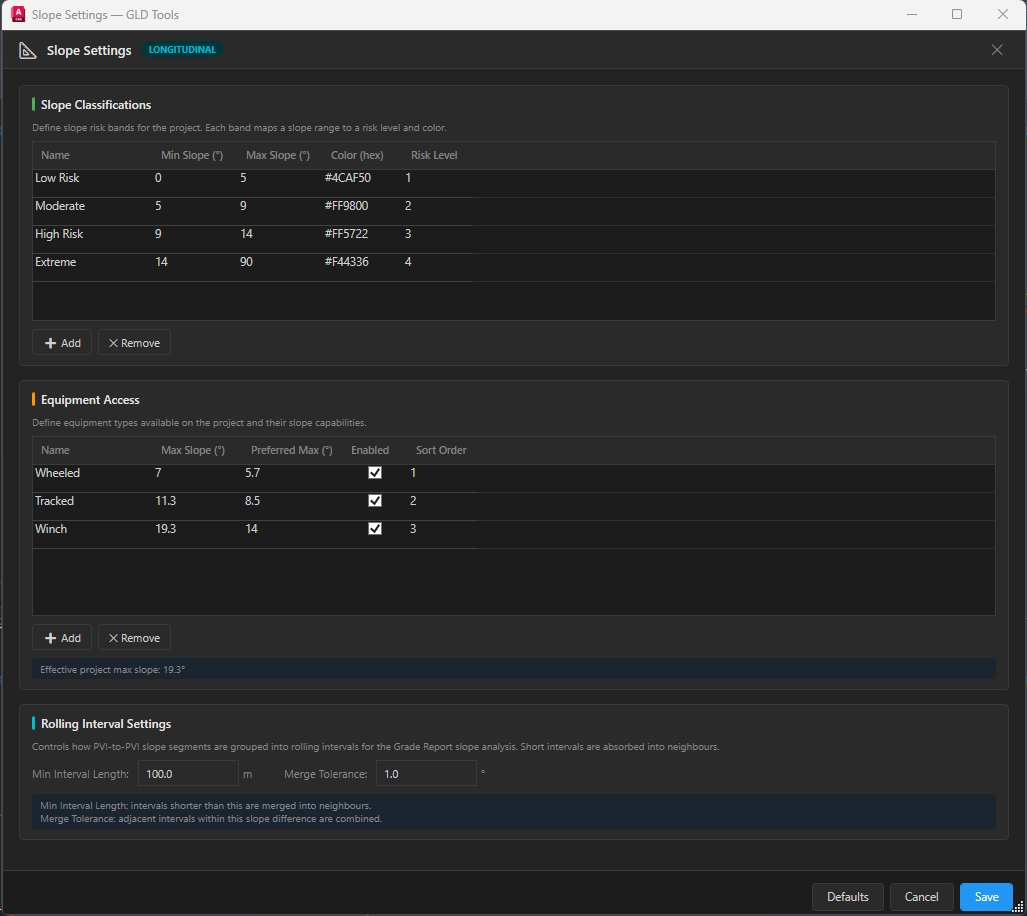
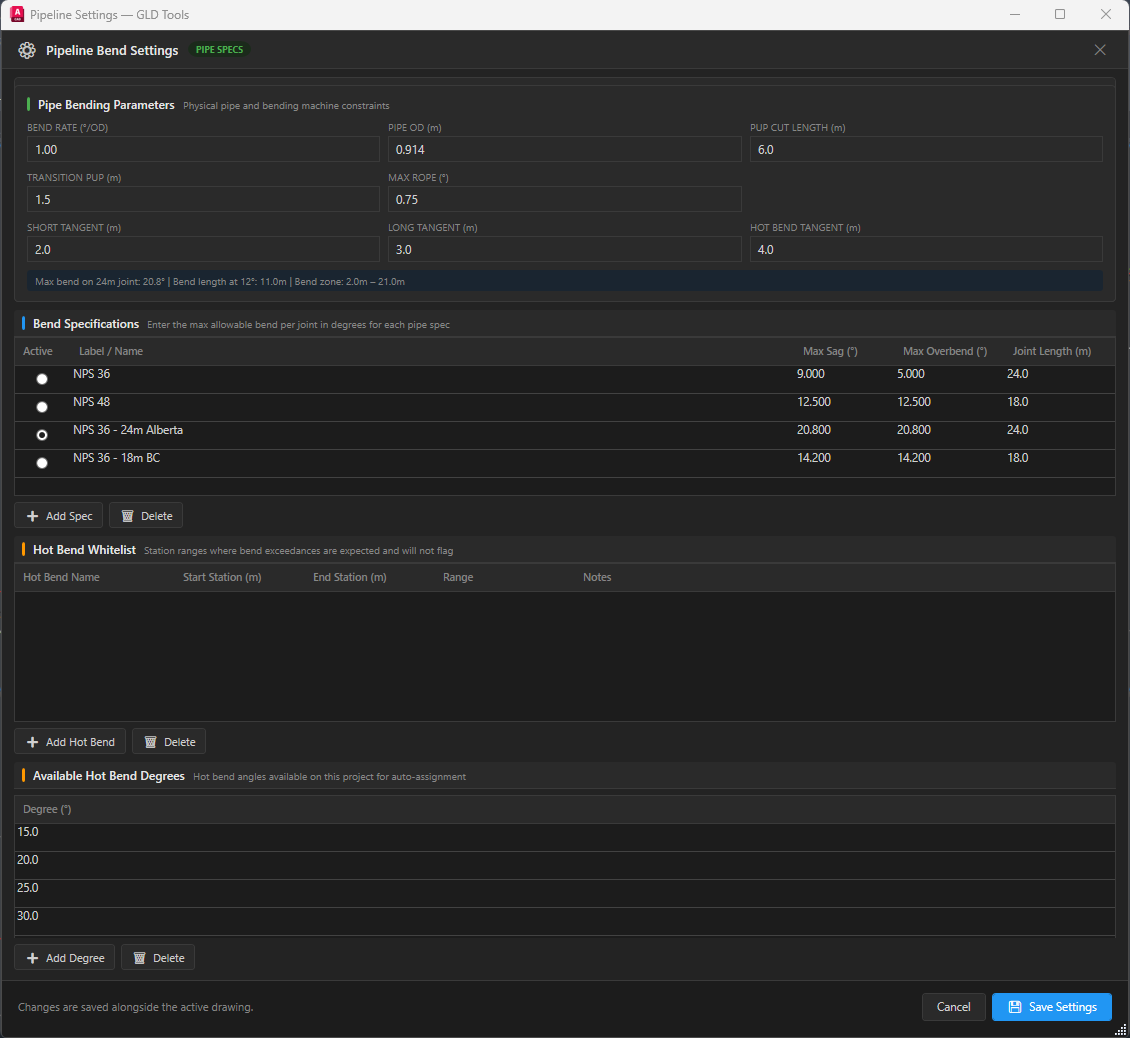
Separate sag and overbend deflection limits checked at every PVI against your specification.
Surface-aware cover depth enforcement at every station, not just at PVI points.
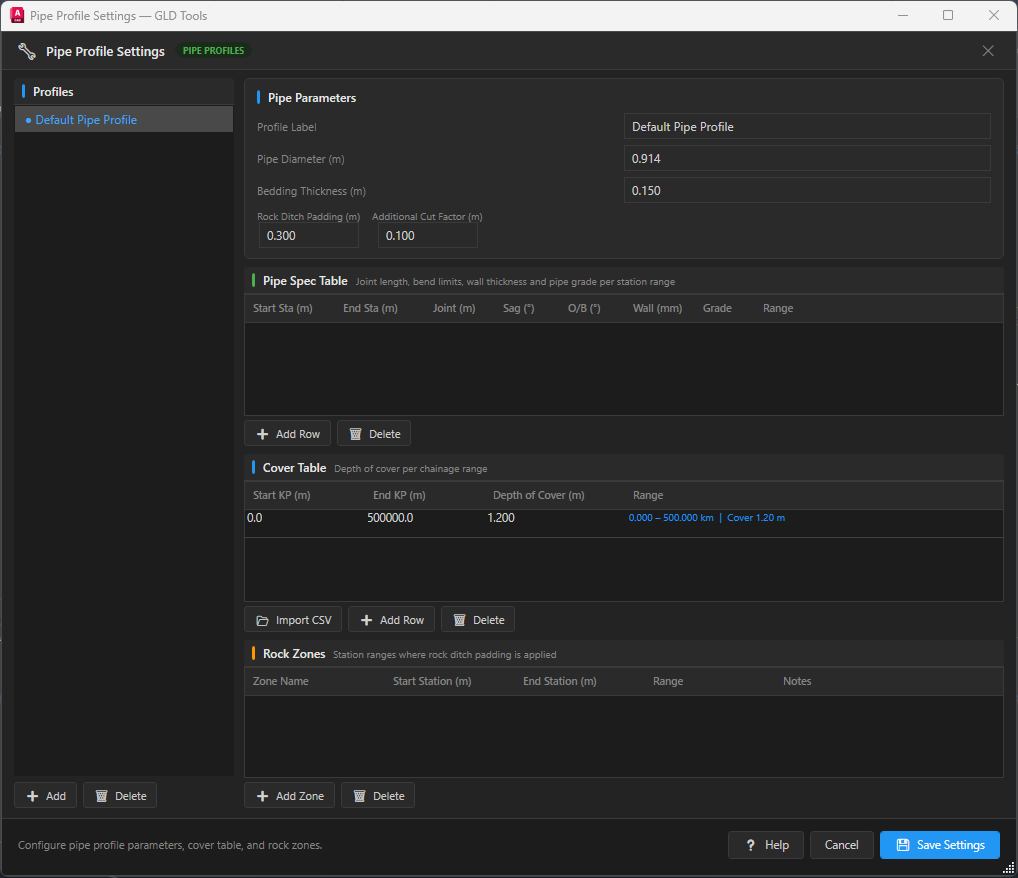
Station-range cover tables with pipe diameter, bedding thickness, and additional cut factors.
Profiles are optimized for constructability — not just mathematically valid, but constructable.
Optimization modes that reduce excessive grading and mass haul while maintaining compliance.
Every constraint is configurable
From the CAD designer to the PM tracking delivery timelines.
Responsible for producing constructible profiles under constraint. Iterates pipe sizes, bend specs, and cover requirements across dozens of alignments per project.
Accountable for schedule and quality across multiple active corridors. Senior staff are stretched thin. Late-stage rework is the most expensive risk on the project.
Evaluates tools against deployment risk, training cost, and integration overhead. Needs clear ROI tied to measurable schedule and cost reduction.
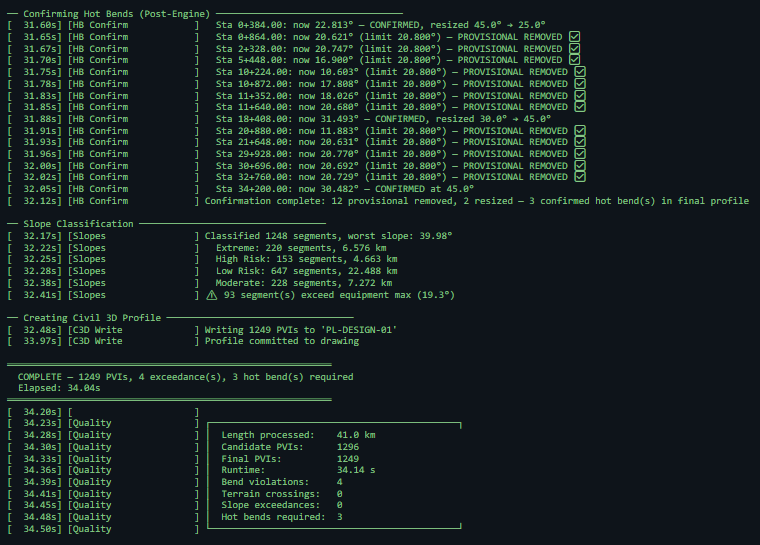
═══ GLD Tools — Auto-Profile Generation Log ═══ ══ Start: 0.0 m End: 40,998.8 m Joint: 24.0 m —— Pass 1: Adaptive Coarse Sampling [ 10.38s] Completed — 1,296 candidate PVIs sampled —— Pass 2: Terrain Ceiling (1 m resolution) [ 20.11s] Completed — 40,998 ceiling samples —— Phase A: Bend Compliance [ 20.26s] Converged after 4 passes [ 20.28s] Pruned 1296 → 1,263 PVIs —— Engine Optimization [ 22.36s] ✅ Avoided 3 hot bends via grade redistribution [ 22.66s] All segments below grade after 25 fix passes [ 22.93s] Polish raised 1,627 PVIs to minimize cut —— Hot Bend Confirmation [ 32.94s] 12 provisional removed, 2 resized 3 confirmed hot bends in final profile —— FINAL VALIDATION PVIs: 1,249 Violations: 4 Crossings: 0 ✅ Hot bends: 3 COMPLETE — Elapsed: 34.04s
This is a real engine run on a production corridor — not a demo. PipeGrade Pro processed the full alignment, optimized the grade, and wrote the profile to Civil 3D in a single run.
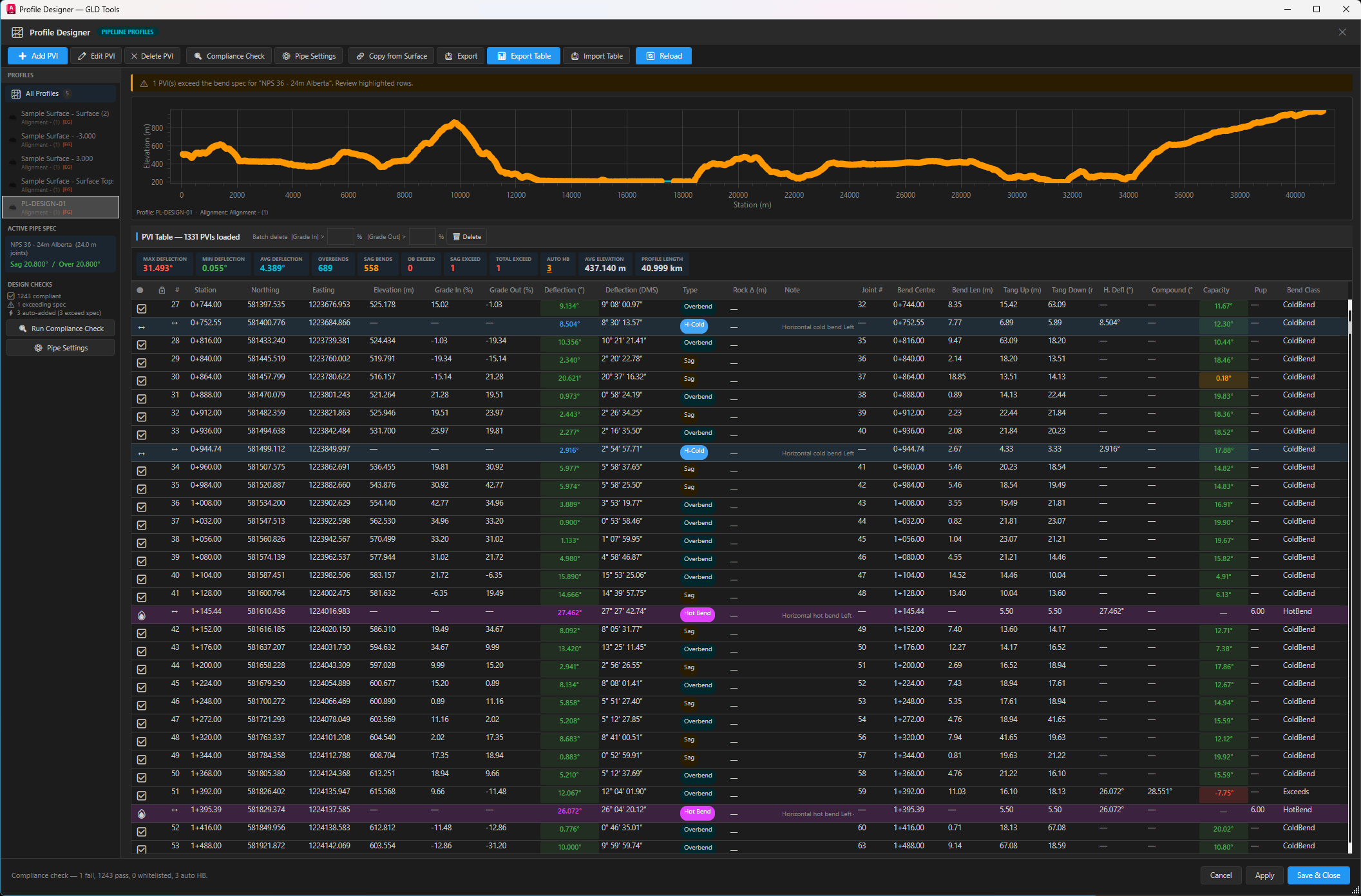
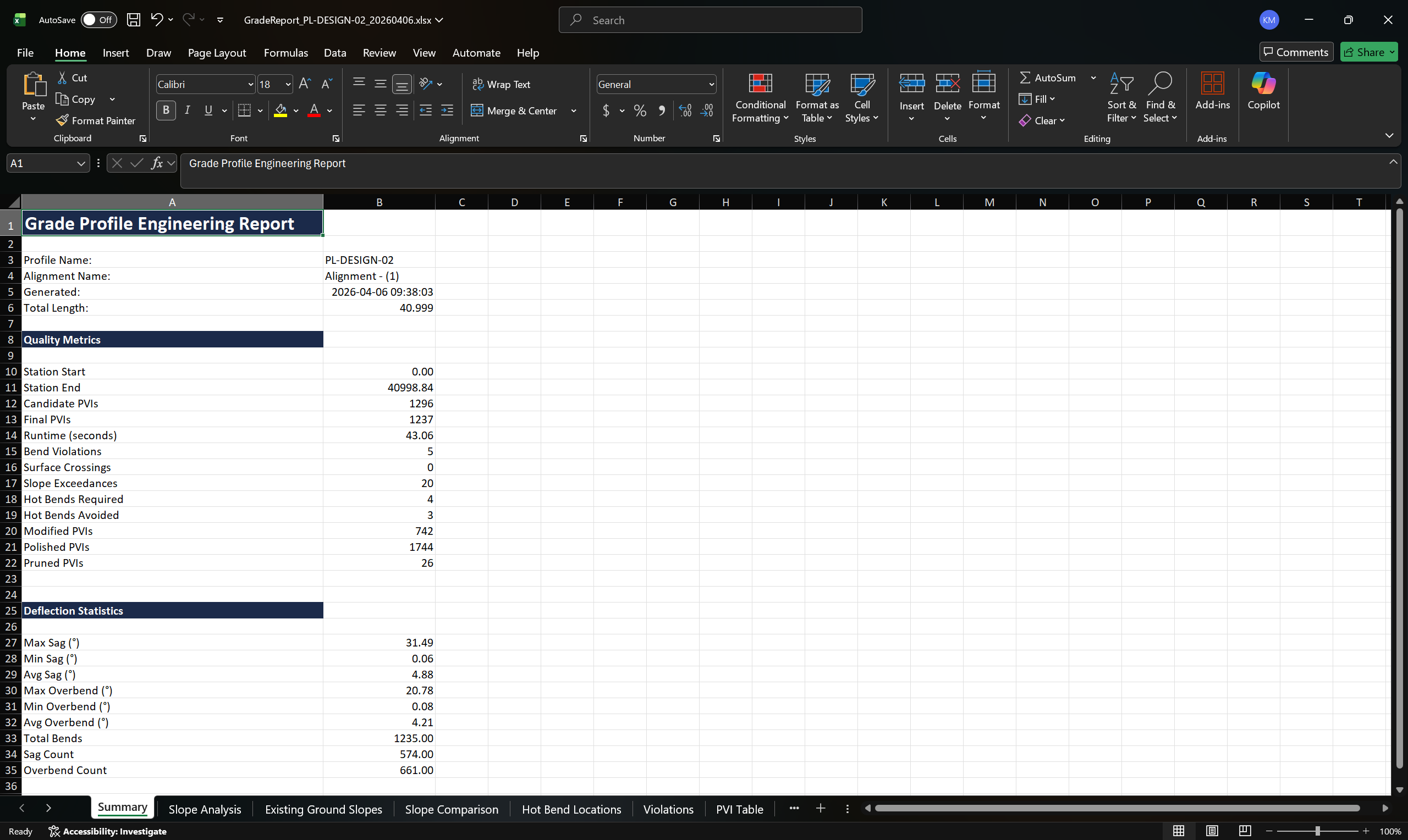
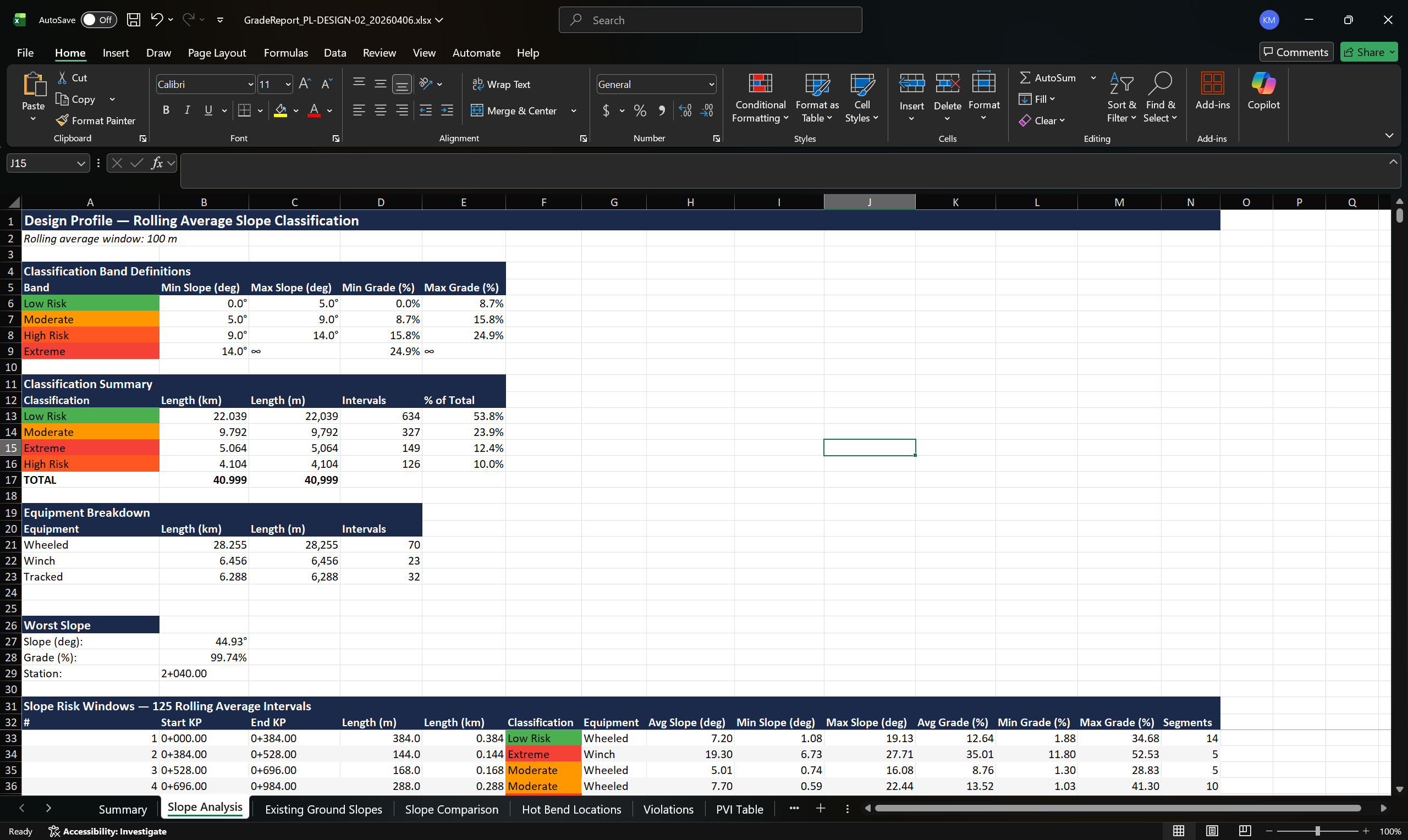
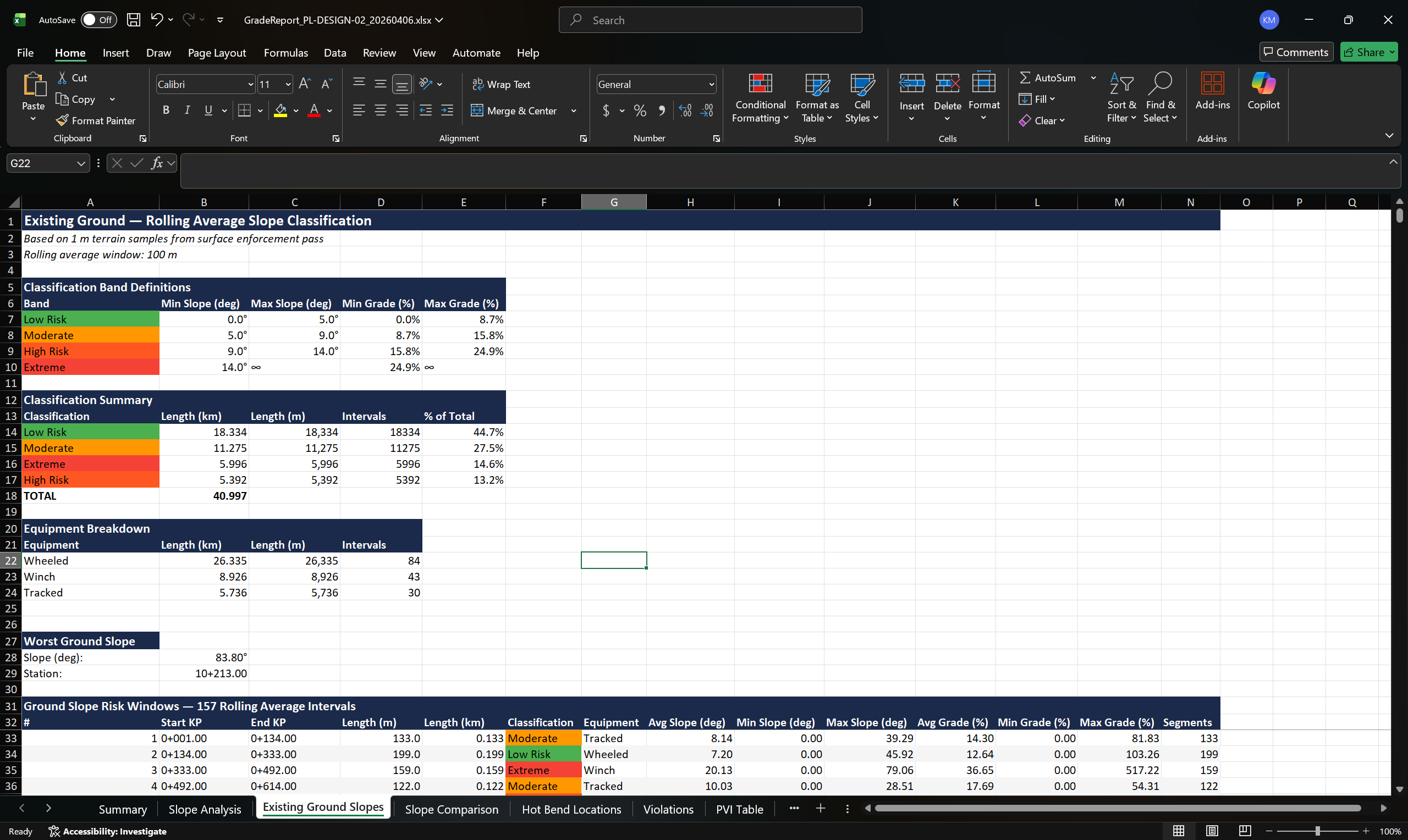
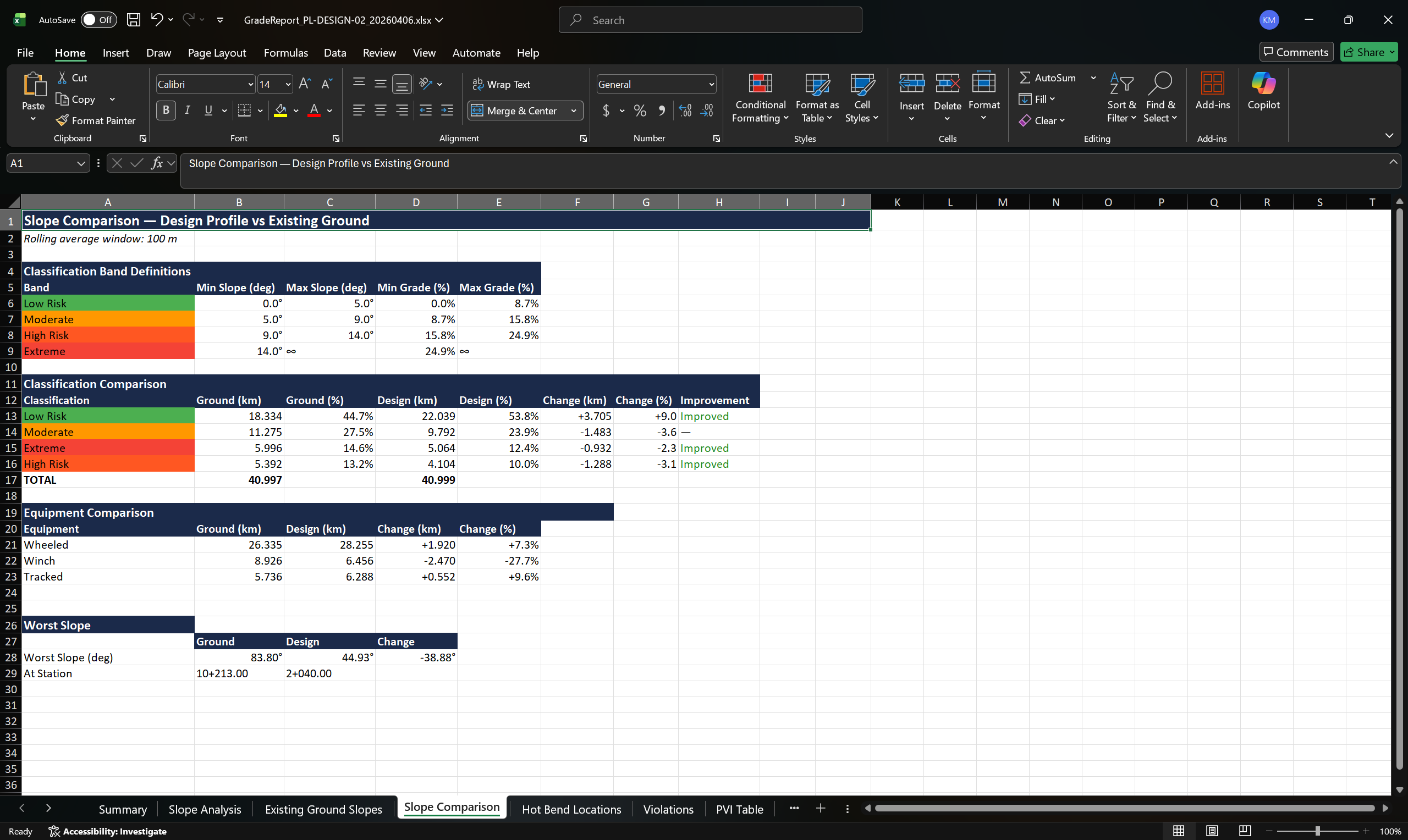
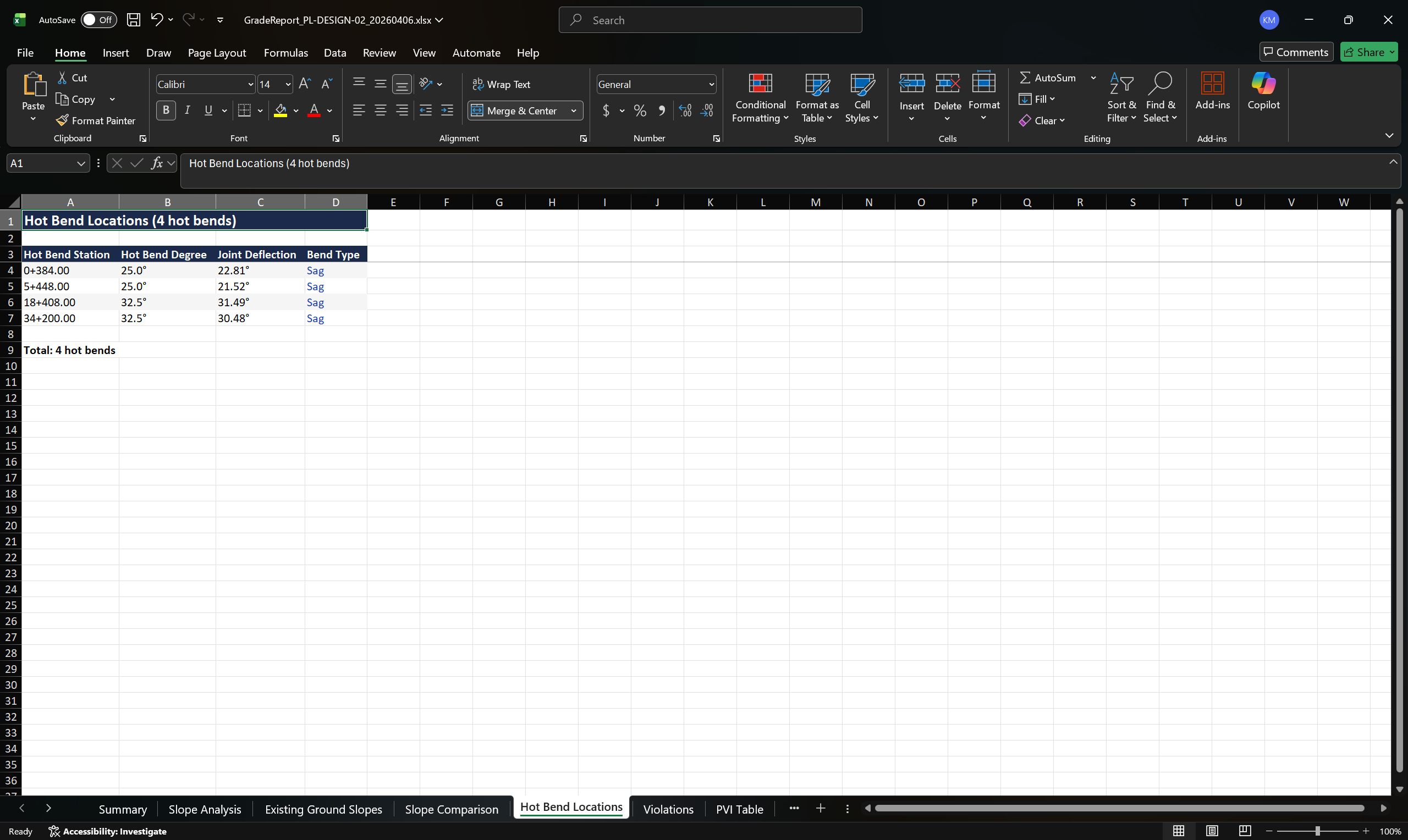
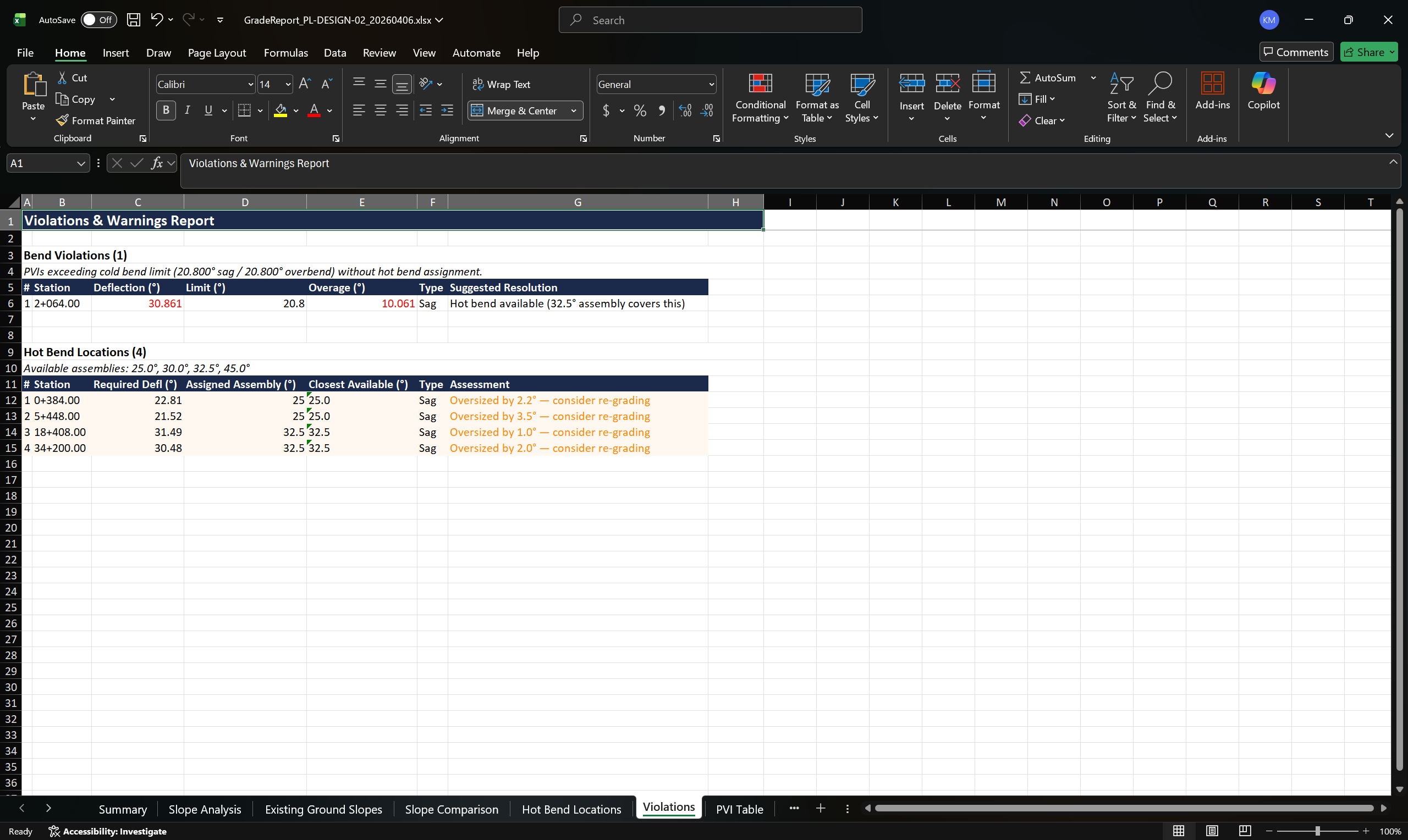
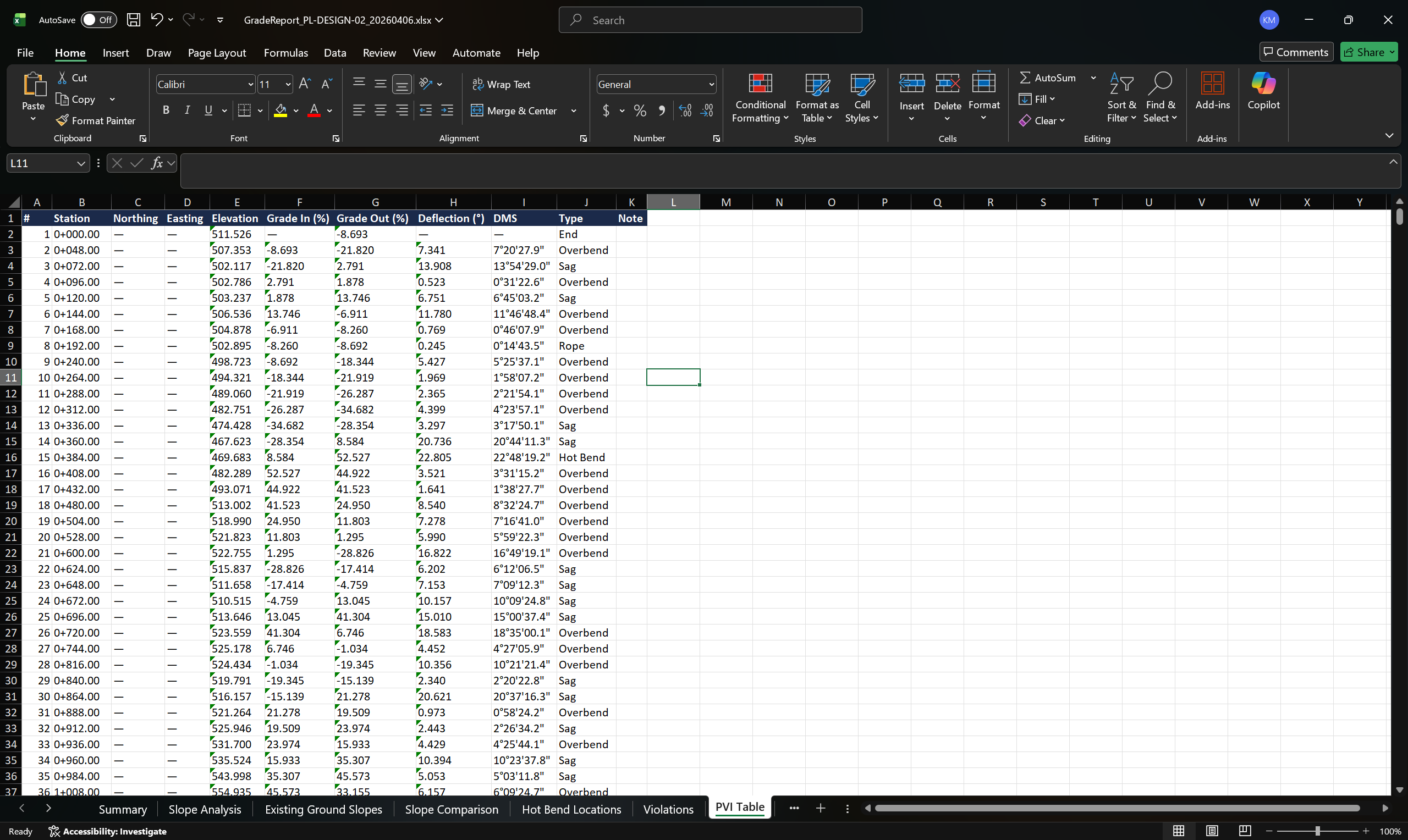
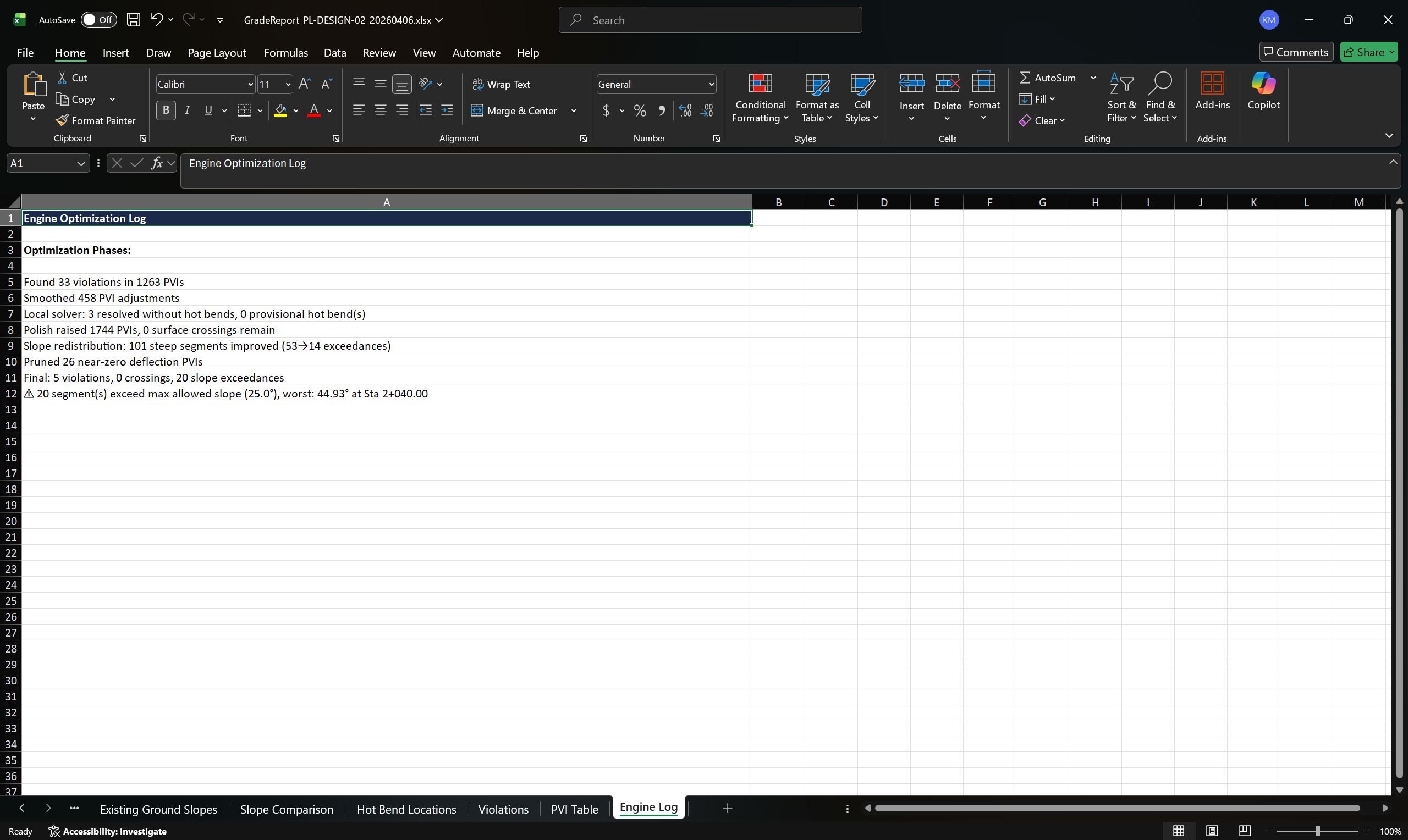
Every run produces a complete Grade Profile Engineering Report — not a summary, but a full record of the engine's decisions. Every constraint applied, every violation resolved, every optimization pass logged. The output is built for third-party review and internal QA sign-off.
Grade Profile Engineering Report — PL-DESIGN-02, 40 km corridor. Click any tab to explore.
Ground Level Design Inc. builds tools for the engineers who build infrastructure. We develop professional-grade software for civil engineering and linear infrastructure design, with a focus on Autodesk Civil 3D integration.
GLD Tools grew out of real project demands — major pipeline programs where grade planning had to keep pace with construction schedules, not hold them back. We needed to iterate pipe sizes, bend specs, and joint configurations quickly enough to support constructability assessments, cost-driven route selection, and permitting submissions — all before a single stake went in the ground.
Today, teams use GLD Tools across the full project lifecycle: early-stage footprint and corridor evaluation, detailed grade generation for design deliverables, construction slope and equipment access planning, and machine control-ready profile exports. The goal is the same at every phase — identify issues early, reduce rework, and minimize project costs.
Give us one real project corridor. We run it through the engine alongside your team's manual process. You keep the validated output either way — we want your honest comparison.
Book a Workflow Review →Founder-led, no generic sales pitch — a real conversation about your projects and how the engine performs against your team's manual process.